For life-science R&D labs
Intelligent Digital Infrastructure for Life Sciences R&D
Modern biology demands digital infrastructure that adapts in real time. Cypher generates experimental design, sample tracking, instrument integration, analysis pipelines, and CRO orchestration on demand.
Free plan, no card.
SOC 2 Type II Compliant SOC 2 Type II Compliant
Used by 1000+ scientists at






The problem
Life sciences R&D is drowning in complexity.
How it works
How Cypher works.
Describe
Scientists describe what they need in natural language to Cypher.
Build
Cypher generates your ELN, LIMS, reusable analysis widgets, bioinformatics pipelines, and CRO marketplace orchestration, on demand.
Adapt
When experiments change, the digital infrastructure adapts instantly.
Cypher's value compounds over time: every workflow generated and every dataset connected becomes part of your organization's institutional knowledge.
Products
Five products, one underlying platform.
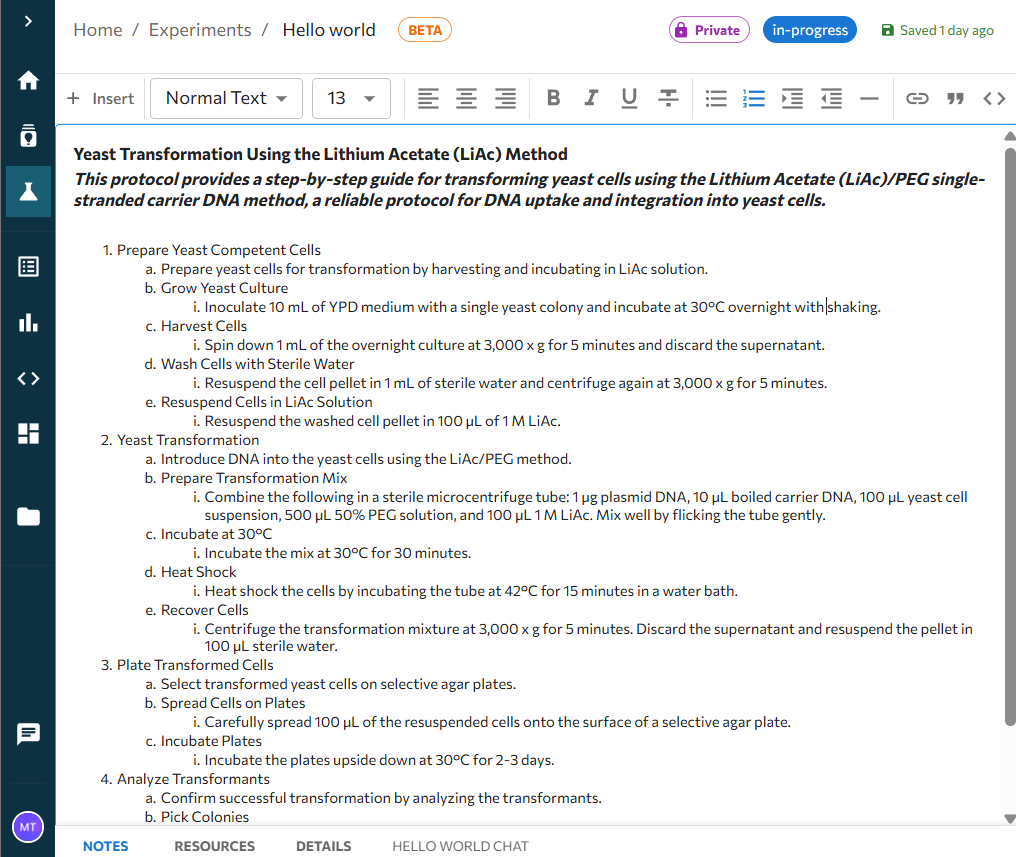
Cypher AI ELN
A living record of every experiment: searchable and audit-ready.
- Structured experiments
- Full audit trail
- Electronic signatures and review
- AI that has your experiment context
Cypher AI LIMS
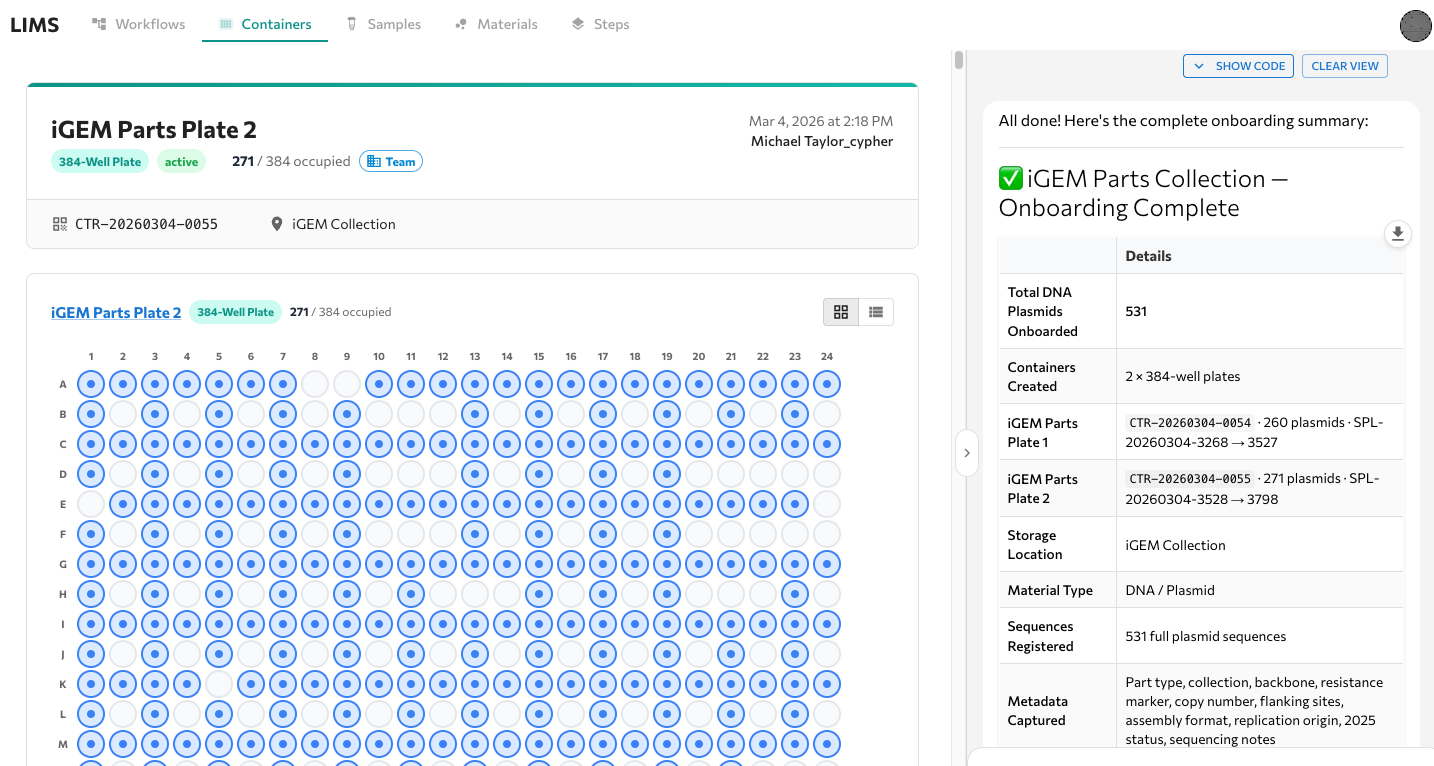
Samples, containers, and workflows with full lineage tracking. Flexible enough for real biology.
- Samples, materials, and containers
- Full lineage and ancestry
- Workflows: model a lab process once, then track every run's inputs, outputs and status
- Auto-IDs, container barcodes, and audit trail
Data Analysis & Dashboards
Describe the analysis you want. Get working code, real outputs, and a reusable tool your whole team can use.
- Reusable widgets: your team's analysis library
- AI-assisted analysis on real data
- Interactive dashboards
- Connected to your lab data
Created by Michael Taylor
Bioinformatics Pipelines
Run reproducible, Git-backed pipelines on scalable compute, with inputs, outputs and history in one place.
- Git-backed, reproducible definitions
- Scalable cloud execution
- Execution history and Pipeline Storage
- Connected to samples and analysis
Sandwich ELISA for one analyte, run in duplicate on up to 40 samples.
Full-length plasmid sequence from purified DNA, with a consensus map.
Screening, confirmatory and titer tiers, developed and validated for your molecule.
Dose-response viability in three cell lines, with IC50 fits.
Cypher AI Marketplace
Find lab services from 17 listed providers, order them in Cypher, and track each order to delivery.
- Browse without an account
- Order at a listed price or request a quote
- Track status, messages and files on one order page
- For providers: list your services, 5% only on completed orders
The agent
It reads your records, proposes changes, and waits for you.
Looking things up never asks. Changing anything shows a preview card first.
 Cypher is thinking...closeCancel
I'll aliquot SPL-20260915-0042 into 8 new tubes at 50 µL each and place them in box A4. Review the plan below and approve to apply it.
8tubeSPL-20260915-0042Done. Eight 50 µL aliquots of SPL-20260915-0042 are now in box A4 as CTR-20260922-0433 to CTR-20260922-0440, and the source tube is drawn down to 100 µL.
Hover to pause
Compare the activity of eight BVMO variants on the plate 3 substrate.
- Clarified lysates of variants V1–V8, expressed Tuesday in BL21(DE3).
- 50 µL of each lysate in A1–H1 of a new 96-well plate, "Enzyme screen plate 3".
- NADPH depletion at 340 nm, 30 °C, read every 30 s for 20 min.
- Enzyme dilution: 1:1000 in 50 mM Tris-HCl, pH 7.5.
Cypher is thinking...closeCancelThis entry describes eight lysates that aren't in LIMS yet. Here's the plan — nothing is written until you approve.
Enzyme screen plate 396-well-plate8A1, B1, C1 … H1 (8 wells)50 µL2sDone. "Enzyme screen plate 3" is in LIMS with the eight lysates in A1–H1, 50 µL each.
2sReview the 1-step plan below, then Approve to apply all of it or Reject (with a note) to revise.
Create a protocol for E. coli protein expression with IPTG induction, optimized for our BL21 strain.1m 12sExpression of a His-tagged protein in BL21(DE3): starter culture, scale-up to mid-log, IPTG induction and harvest.
🔗 Open Full ProtocolDissolve 25 g LB broth in 1 L deionized water and autoclave.
20:00editplay_arrowstopOnce cooled, add kanamycin to 50 µg/mL.
It's saved as v1 in your protocol library. Open it to start a run, or tell me what to change.
6sAll eight samples grew. V3 and V7 had the highest maximum growth rates; V5 was slowest and plateaued lowest. Fitted values for all eight are in data.csv.
| Sample | µmax (h⁻¹) | Doubling time (min) |
|---|---|---|
| V3 | 0.92 | 45 |
| V7 | 0.88 | 47 |
| V1 | 0.71 | 59 |
| V5 | 0.38 | 109 |
1sReview the 1-step plan below, then Approve to apply all of it or Reject (with a note) to revise.
Turn the OD600 growth-rate analysis from this chat into a reusable widget a coworker can run on their own plate files.38sPlots OD600 over time and fits each sample's maximum growth rate.
Growth rate fit is in your widget library, built from the analysis script in this chat. To share it with your coworker, open the widget and choose Sharing from its menu, then add them as a team member.
Hello! What widget would you like me to create? I'll help you create a Python script that can be turned into a UI for you or others to run.
Here's a ΔΔCt widget. It normalizes each target to the reference gene, compares every sample to the control, and reports 2^-ΔΔCt with a bar chart.
Added a max-ct-spread input (default 0.5). Samples whose replicates spread more than that are flagged in the table.
- Reads your ELN entries, inventory, protocols, files, PubMed
- Writes samples, readings and protocols after you approve
- Every approval logged with your name
Across the platform
The same agent, across everything in Cypher.
Control
You control the agent and your data.
Claude or GPT. Your admin decides which models your team can use.
Enterprise runs in your cloud account in the US, EU or China, with SSO.
Flat per-user plans, with unlimited AI messages on Pro. You pick the compute each run uses.
Compared
Cypher vs. traditional labs.
"Traditional ELN" describes the common pattern, not any one product.
Customers
What teams use it for.
"We started working with Cypher just a month ago, and the value is already off the charts. This is the platform I've wanted my entire career. The automation, the data pipelines, and the order management, it all just works."
 Matthew YoungblutCSO, Flock Bio
- API integrations and Google Drive sync
- File- and pipeline-triggered automations
- Marketplace ordering
"Cypher has shortened our development cycles and ensured that science problems get solved accurately and quickly. We're able to use Cypher to create automated solutions that run in the background and reduce friction."
 Eli ZhangCEO, WayBio
- Widgets and background automation
- Sequencing orders from their own deployment
- SSO
A top-10 pharma company runs design of experiments on a single tenant deployment, single model provider, no analytics.
Not named under NDA.
- Computed designs with power and efficiency
- Single-tenant deployment
- Provider restriction
Solutions
Built for life sciences R&D teams.
Security and deployment
Private. Audited. Yours.
Report at trust.cypherbio.ai.
In your own cloud. US, EU or China.
SSO; scoped API keys; write-only keys for CROs.
Restrict the agent to one provider per deployment.
Signature-on-completion, review and audit trail, switched on per team.
Field-level change tracking; recoverable deletions.
Pricing
Start with our free tier.
Free
For small projects and basic analysis
- 15 AI messages / month
- Unlimited public projects
Pro
For teams that collaborate and automate their workflows
- Expanded AI usage, with advanced models from OpenAI and Anthropic
- LIMS and team features
- Advanced widget features and more compute
- 100 GB file storage
- SOC 2 Type II Compliant
Enterprise
For organizations that need higher security and data residency
- Your own deployment, with dedicated data residency
- SSO, permissions and compliance controls
- Custom data integrations
- A dedicated engineer and priority support
- Discounted professional services
Startup and academic pricing
Pro at a lower price, for teams that qualify.
Startup Program
90 days free, then 75% off Pro for year one
Who qualifies
- 20 or fewer scientists
- Under $30M raised
- New to Cypher
- Larger companies may qualify through a partner
Academic Program
Up to 50% off
Who qualifies
- An accredited university, college or research institute
- Faculty, graduate students and research scientists
- Active research in the life sciences or biotech
- Willing to take part in a case study
CROs and service providers: list your services on the Marketplace.
FAQ
Questions about Cypher.
What is Cypher?
Cypher is an AI-native ELN and LIMS for life-science R&D teams. Scientists record experiments, track samples, run analyses and bioinformatics pipelines, and order outside lab work in one platform, with an AI agent that works from their own data. Teams can start on the free plan, or run Cypher in their own cloud on Enterprise.
How much does Cypher cost?
Cypher has three plans. Free is $0 with 15 AI messages a month. Pro is $100 per user per month with expanded AI usage, the LIMS, team features and 100 GB of storage. Enterprise starts at $25K per year, for organizations that need a higher level of security and data residency. Startups and academic labs that qualify pay less, through the Startup Program and the Academic Program.
What can the Cypher AI agent do?
The Cypher AI agent reads your ELN entries, samples, protocols and files, and proposes the work: drafting text, running analyses, and creating samples, protocols and widgets. Before it saves a protocol or widget, it shows you a plan to approve. LIMS writes wait for your approval too, unless you switch the chat to Auto. Analyses run straight away, in Python you can read.
Which AI models does Cypher use?
Cypher uses Anthropic Claude and OpenAI GPT models. An admin chooses which models a team can use, and Enterprise deployments can be limited to a single model provider.
Is Cypher secure?
Cypher is SOC 2 Type II compliant, and its controls are listed at trust.cypherbio.ai. Cypher does not use customer data to train AI models, its own or any third party's.
Can we run Cypher in our own cloud?
Yes, on the Enterprise plan. Cypher deploys into your own cloud account with data residency in the US, the EU or mainland China, SSO sign-in, priority support and a forward-deployed engineer who helps set up your workflows.
Is Cypher an alternative to Benchling?
Yes. Cypher covers the core jobs of an ELN and LIMS, recording experiments and tracking samples with lineage, and adds an AI agent, analysis tools that become reusable widgets, Nextflow pipelines and a lab services marketplace on the same platform. Teams already on Benchling can also run Cypher alongside it to add those capabilities. Teams can start free and move spreadsheet inventories in with the agent.
Does Cypher offer discounts for startups and academic labs?
Yes. Biotech startups with 20 or fewer scientists, under $30M raised and new to Cypher can join the Startup Program: 90 days free, then $25 per user a month for year one and $50 for year two. Larger or later-stage companies referred by a partner incubator, accelerator or fund may qualify too. Universities, research institutes and core labs may qualify for up to 50% off through the Academic Program.
How do I start using Cypher?
Create a free Cypher account; no card is needed. Write your first experiment in the ELN and ask the agent to help structure it, and book a free 15-minute onboarding call if you want a walkthrough. Upgrade to Pro when you need the LIMS, unlimited AI messages or team features.
Ready to transform your R&D?
Supported by